
How to Check Criminal History in Iberia Parish
No single Iberia search answers every records question. Start with the Iberia Parish Clerk of Court for a district-court charge or outcome. Use the Sheriff’s LAVNS and PublicLogs rosters for present or recent parish-jail custody, then request the initial report from the arresting agency. A statewide self-review belongs with Louisiana State Police through LAPS, not with a parish name search.
Before searching, collect the full legal name, date of birth when lawfully available, spelling variants, event date, arresting agency, and any case, report, or booking number. Use identifiers only to distinguish records; a shared name alone is not a safe match.
- Choose the custodian: police for the initial report, IPSO for booking, or the Clerk for the filed case.
- Search with the exact name or docket number and narrow by date, agency, division, or date of birth.
- Compare the result’s identifiers; do not assume that the first similar name is the right person.
- Trace the booking charge forward to the prosecutor’s filed count and the court disposition.
- Order a certified court copy or fingerprint-based Right to Review when an official record is needed.
Why One Iberia Search Falls Short
Iberia’s systems describe different stages. A roster is a custody snapshot. A Clerk file shows what prosecutors filed and how the court acted. LACCH links fingerprint-supported Louisiana arrest cycles to reported dispositions. If the disposition has not reached BCII, the state history may look unresolved even after the court closed the matter.
| Question | Best first channel | Important limit |
|---|---|---|
| Is someone in parish custody? | LAVNS roster | Custody is not guilt or a final charge. |
| What was filed and decided? | ClerkConnect and Clerk counter | City-court matters may be separate. |
| What does my statewide file show? | LAPS Right to Review | Fingerprint appointment and identity proof apply. |
| What did the officer first report? | Arresting agency | Follow-up investigation may be withheld. |
Inside Iberia’s 1941 Courthouse
The parish government’s courthouse view shows the public building at 300 Iberia Street in New Iberia.

The image locates the downtown public-records hub, where the Clerk’s Suite 100 counter is open Monday through Friday, 8:30 a.m. to 4:30 p.m.; background checks stop at 4:00 p.m.
The Clerk’s own homepage identifies the court-record office and its service routes.
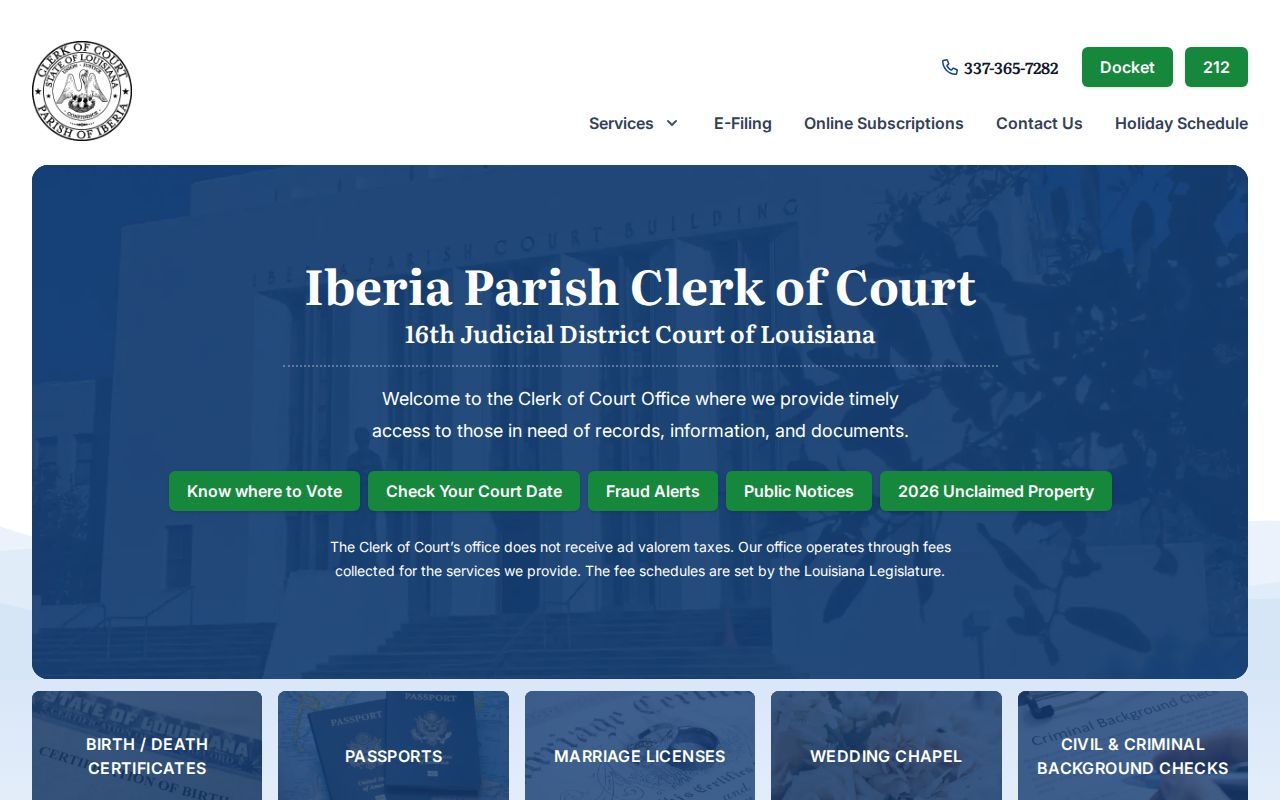
The Clerk view reinforces that filed cases belong with the court custodian, not the sheriff. The courthouse was dedicated on November 11, 1941, and later renovations restored second-floor court spaces. It remains the place to ask for older files, minute extracts, certified judgments, and the proper criminal division. C.C.P. art. 251 restricts privately owned scanning or copying equipment in the Clerk’s office absent a court order, so call 337-365-7282 before bringing devices.
Official Louisiana Background Checks
The Louisiana Department of Public Safety and Corrections, Office of State Police, BCII-LCJIS maintains LACCH. For a person reviewing their own Louisiana record, the certified Louisiana Right to Review through LAPS is the authoritative route. LAPS provides a statewide network of digital fingerprint sites; its scheduler controls the current location, identity-document instructions, appointment, and vendor cost.
The BCII gateway explains LACCH and LAPS access.
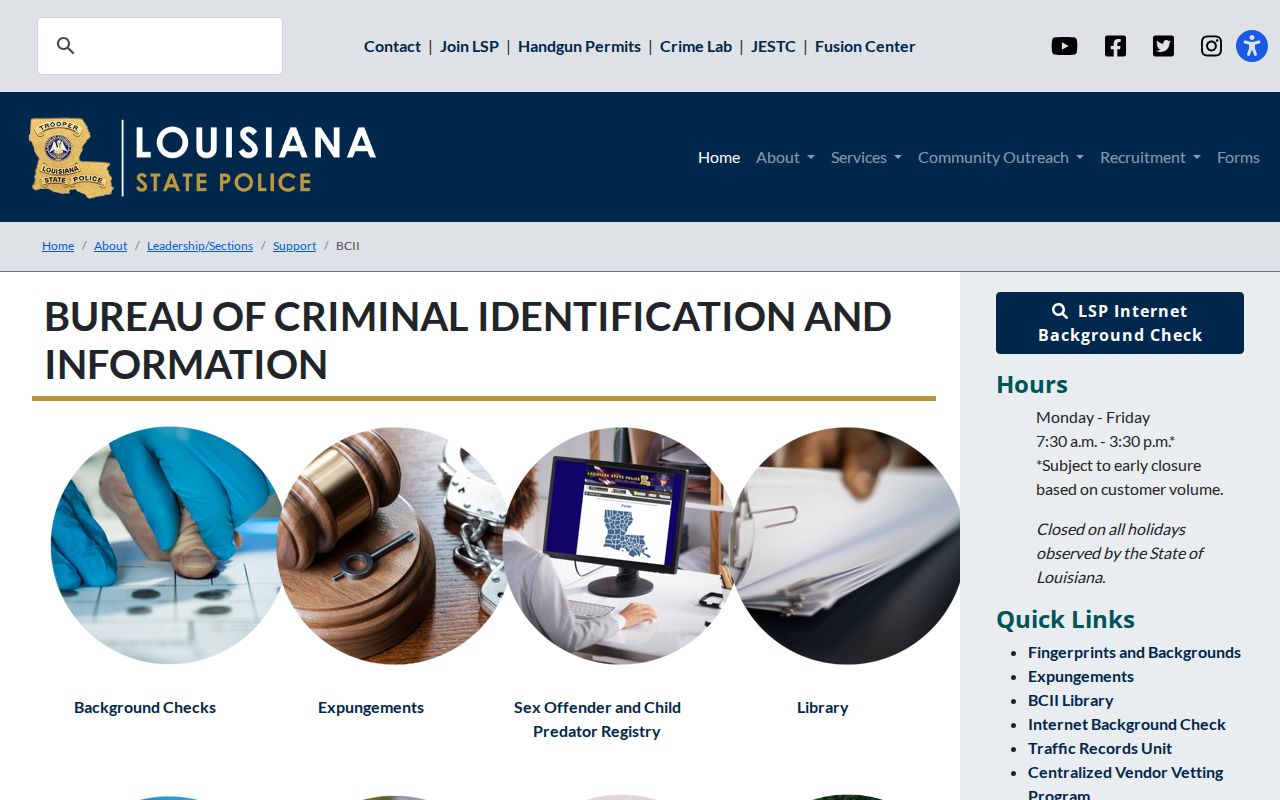
This state route is identity-based and broader than an Iberia Clerk search. The separate LSP authorization form is consent-based and states a $31 Louisiana fee, including the $5 technology fee, plus $13.25 when FBI processing is authorized or required. Fingerprints are needed for positive identification.
The $20 Iberia Clerk Search Gap
The Clerk’s background-check instructions spell out an unusually narrow local product.
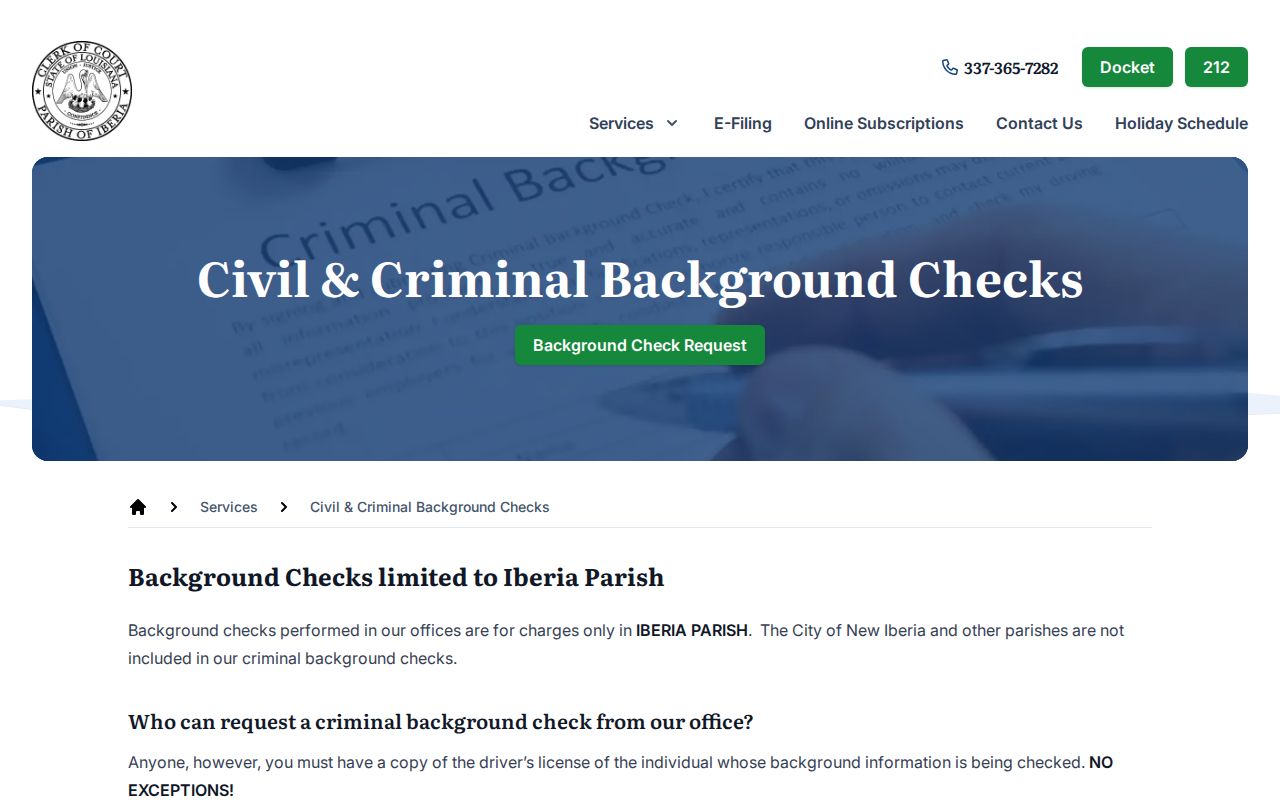
Anyone may request the $20-per-name check, but the Clerk requires a copy of the subject’s driver’s license with no exceptions. The result covers charges in Iberia Parish only and expressly excludes the City of New Iberia and every other parish. Use it to answer what appears in the parish district-court index, not as proof of a complete Louisiana history.
| Product | Known charge | Scope |
|---|---|---|
| Iberia Clerk search | $20 per name | Iberia Parish charges; excludes New Iberia city |
| Regular Clerk copy | $1 per page | Selected court-file pages |
| Certified copy | $5 | Confirm how charge applies to the order |
| Certified minute extract | $15 | Certified docket-minute information |
| LSP authorized check | $31 | Authorized Louisiana state process |
Types of Criminal Records
An Iberia criminal trail is a chain of records, not one document. Police create the initial and arrest reports; the jail creates booking and custody entries; the District Attorney selects charges; the Clerk preserves the case; and BCII receives fingerprint and disposition reporting. Warrants may begin in district, city, or justice court, while Louisiana DOC maintains prison and state supervision information.
- Arrest and booking records: show alleged offenses, intake, bond, holds, and custody changes.
- Criminal court case files: show filed counts, hearings, pleas, disposition, sentence, and costs.
- LACCH entries: link fingerprint-supported Louisiana arrest cycles to reported outcomes.
- Warrants and capias: identify issuing authority, case, reason, and status when lawfully public.
- Supervision and registry records: divide among court judgments, DOC, parole authorities, and the state registry.
Iberia’s Two Roster Searches
The Iberia Parish Sheriff’s Office is the local starting point for jail and booking channels.
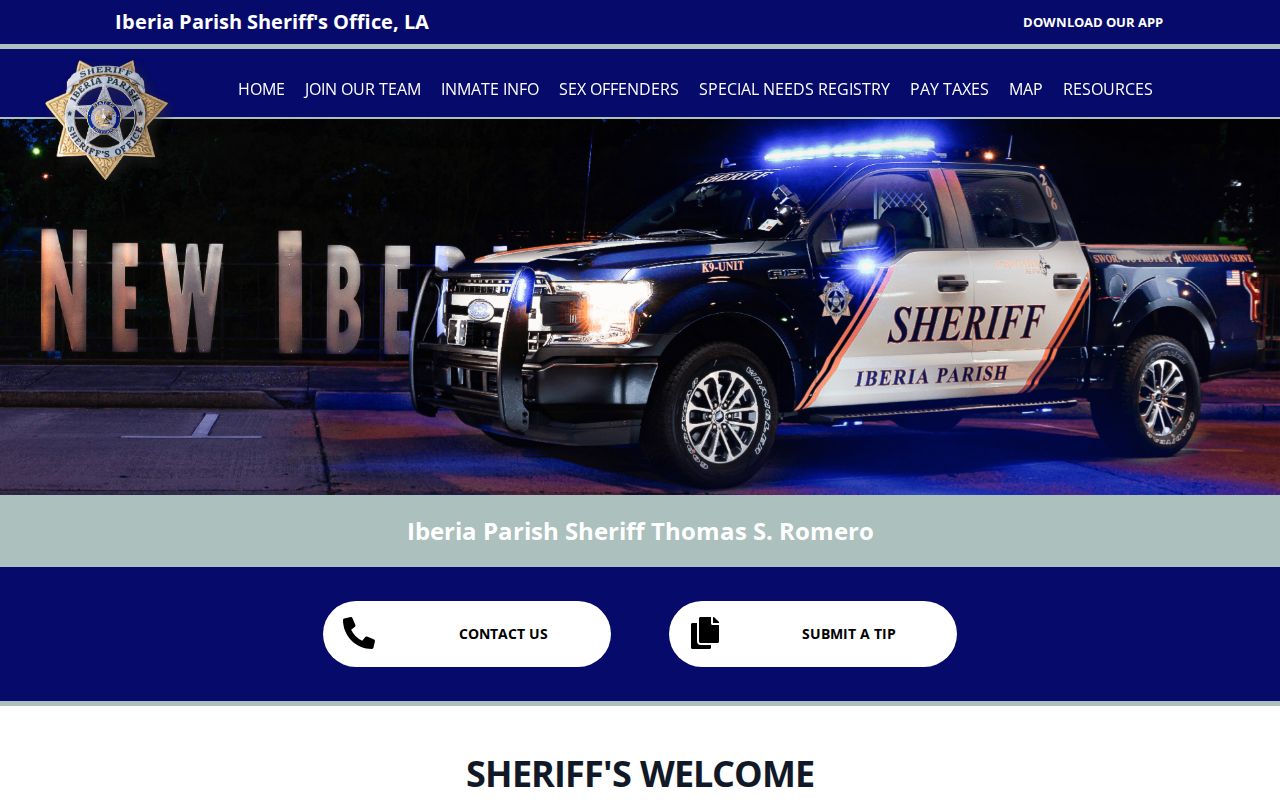
Its two roster doors have different purposes and warnings. LAVNS presents an alphabetized, time-stamped list with name, date of birth, race, gender, and arrest date. PublicLogs describes an active-inmate inquiry but warns that its data is not an official public document and restricts copying or republication without consent. Use either screen only as a location clue. For proof, ask IPSO for the Article 228 booking record.
What an Iberia Parish Criminal Record Shows
The fields depend on the system. A booking screen emphasizes intake and custody. A court file emphasizes counts and outcome. A LACCH history connects identity and fingerprints with arrest and disposition reporting. Public records should omit protected identifiers, victim or juvenile details, sealed material, and expunged content.
| Name & Identifiers | Legal name, aliases, DOB, physical descriptors, state ID, FBI number, and fingerprint transaction identifiers where authorized. |
|---|---|
| Arrest / Booking Data | Agency, report and booking numbers, dates, asserted charges, photograph, fingerprints, bond, holds, and release or transfer. |
| Charges & Statutes | Filed counts, offense description, Louisiana statute, grade, and charging instrument. |
| Disposition | Dismissal, nolle prosequi, acquittal, plea, conviction, or other final action by count. |
| Sentence | Confinement, probation, fines, costs, restitution, and concurrent or consecutive terms. |
| Custody / Supervision Status | Parish jail, state prison, release, parole, or a public court entry concerning probation. |
Reading Iberia Booking Records
One arrest can create four separate trails: the officer’s report, the IPSO booking, a LACCH arrest cycle, and the prosecutor-and-Clerk case. The booking label is provisional. The bill of information or indictment tells what was prosecuted, and the disposition tells whether a count ended in conviction, dismissal, acquittal, or another result.
- Bill of information
- A charging instrument filed by the prosecutor and commonly used in Louisiana.
- Nolle prosequi
- The prosecutor’s formal decision not to continue a charge at that time.
- Capias
- Court process directing arrest, often tied to a missed obligation.
- Disposition
- The outcome of each charge; this is the field to verify before drawing a conclusion.
Public Access Laws
Louisiana Public Records Law begins with access but preserves specific exceptions. Ask the actual custodian for a narrow, identifiable record and request inspection, electronic delivery, redaction, or a cost estimate. R.S. 44:3 can protect investigative work, sources, techniques, and pending-litigation material; it does not erase the statute’s express public status for initial reports, bookings, citations, summonses, and filed bills of information.
Key Statutes:
R.S. 44:1: defines public records broadly across physical and electronic government material.
R.S. 44:31: permits inspection and copies and places the withholding burden on the custodian.
R.S. 44:3: protects defined law-enforcement material while preserving access to named initial and booking records.
C.C.P. art. 251: makes the Clerk court-record custodian and governs inspection and copying.
C.Cr.P. art. 973: makes an expunged record confidential while retaining limited authorized access.
Routing Iberia Records Requests
Most IPSO departments consolidated at 4701 West Admiral Doyle Drive after the parish acquired the 24,000-square-foot headquarters in 2022. Court files did not move there. The Clerk remains downtown, and jail or booking inquiries may require a separate contact. A request should name the event date, place, person, report or booking number, exact record, delivery format, certification need, and a fee ceiling.
If IPSO denies or delays access, ask for the precise exemption and reasonably segregable public portions. The research found no complete official IPSO online form or dependable fee schedule, so do not assume a price or turnaround. Use the official contact route, verify the records unit, and preserve the request and response.
The requested product also matters. Ask the arresting police agency for the initial incident narrative, IPSO for the booking record, and the Clerk for a filed bill, minute entry, judgment, or certified disposition. Include the date, approximate time and location, involved name, and any report, booking, or docket number. State whether you want inspection, an electronic copy, paper, or certification, and request notice before costs exceed a chosen limit. If a follow-up investigation is withheld under R.S. 44:3, that does not automatically make the initial report or Article 228 booking record secret. Ask the custodian to identify the precise exemption and release any public portion that can reasonably be separated.
Sealed, Expunged & Restricted
Juvenile records, protected victim and minor data, confidential sources, pending-case investigative supplements, sealed filings, and expunged matters are not ordinary public records. Louisiana expungement makes an eligible record confidential rather than universally deleting it. Article 973 retains access for criminal-justice agencies, the subject or counsel, and other specifically authorized users.
The Iberia Clerk supplies separate set-aside and expungement forms but cannot give legal advice. Eligibility depends on the outcome, offense, waiting rules, and statutory exclusions. Dismissal or release from jail does not automatically expunge the booking. After an order, allow agencies time to update, recheck the Clerk index, and obtain a new Right to Review before challenging a remaining repository entry.
Iberia Expungement’s Paper Rule
The Clerk’s local expungement instructions require forms printed on 8.5-by-14-inch legal paper and state that fees are nonrefundable. The packet may require the docket, arrest date and agency, offense and statute, outcome, eligibility ground, prior expungements, service list, certified disposition, and ground-specific proof. The current Iberia fee sheet, not a generic statewide estimate, controls the amount. A person should verify the packet, parties to serve, and any waiver or exception before filing.
When Iberia Custody Moves to DOC
The Louisiana Corrections site provides the state “Locate a Person in Prison” route.

A person can disappear from an active Iberia roster after release or transfer without the case being dismissed. Use the DOC locator for sentenced state custody. For custody-status alerts, the Louisiana VINELink service offers a separate notification channel.

VINELink is for status and notification, while the Clerk judgment and sentence remain the court record. Detailed probation files are not an open public name database; Louisiana supervision is state-run through DPS&C.
Criminal Records by City in Iberia Parish
Municipal police hold their own reports, while city courts can preserve traffic, ordinance, and misdemeanor matters outside the parish district-court trail. New Iberia’s policing also has a date boundary: NIPD resumed patrol July 1, 2018 after nearly a decade of IPSO contract service. Jeanerette maintains separate police, city-court, and marshal roles. Delcambre crosses the Iberia-Vermilion line, so an address controls the jail, clerk, and district court route.
New Iberia Criminal History
26,849 (2024 estimate) · NIPD reports and New Iberia City Court require distinct checks.
Jeanerette Criminal History
4,813 (2020 Census) · City police and city-court channels remain separate from IPSO booking.
Delcambre Criminal History
1,815 townwide (2020 Census) · Confirm the parish side from the event address.
Iberia Federal Records Lead to Lafayette
Iberia Parish federal cases belong to the Lafayette Division of the U.S. District Court for the Western District of Louisiana. The federal courthouse page identifies the John M. Shaw U.S. Courthouse in Lafayette.
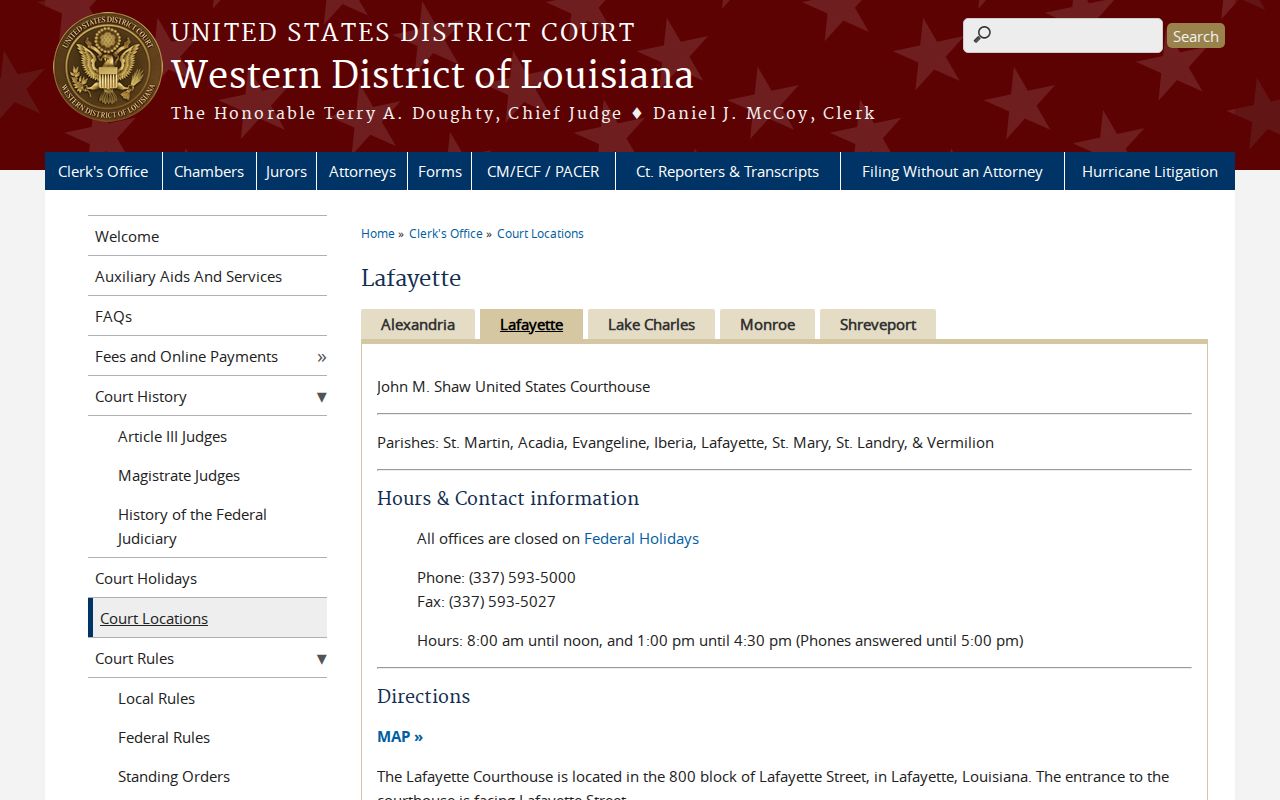
Use PACER for federal dockets and documents, the Bureau of Prisons locator for federal custody, and the FBI Identity History Summary process for one’s own fingerprint-linked federal history. Those systems do not replace IPSO, the 16th JDC, Louisiana DOC, or LACCH.